
Pakistan's Real Business Problem Isn't Software. It's the People Who Run It.
Software isn't the problem in Pakistani businesses. Untrained staff and unclear plans are. Learn why systems fail and a 6-step plan to make yours work.
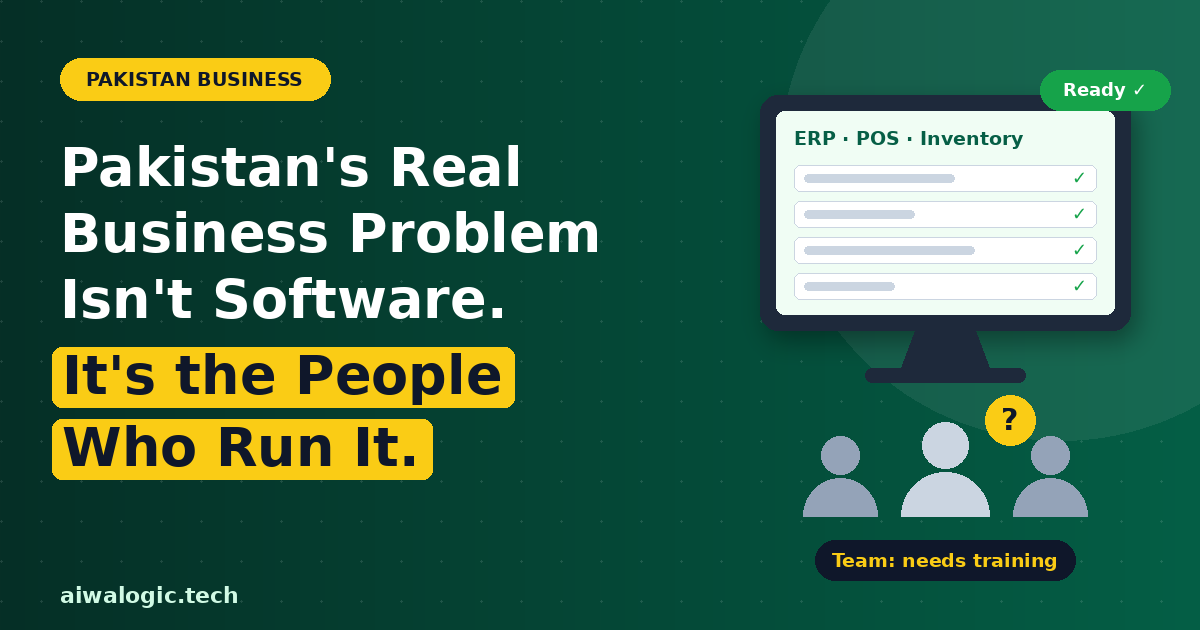
A distributor in Sheikhupura spends lakhs on a new inventory system. Six months later, the stock report still doesn't match the warehouse. Sales are entered late, some invoices are still on paper, and the owner is back to checking registers by hand.
The owner blames the software. But the software was never the problem.
Across Pakistan, business owners tell the same story. The real problem isn't the computer system. It's the people entering the data. Good software is available and affordable today. What's missing is a team that's trained and ready to use it, and an owner who has a clear plan for how to get there.
In this article, we'll explain:
• Why the software itself is rarely the problem
• Why staff, not systems, decide whether your investment pays off
• Why many owners hold back from investing at all
• A simple 6-step plan to make your business system actually work

The Software Already Exists
Ten years ago, a Pakistani business owner had a real excuse: good systems were expensive, foreign and hard to adapt. That's no longer true.
Today you can get software built for how Pakistani businesses actually work:
• ERP systems to run accounts, purchasing, sales and HR in one place
• POS software for shops, restaurants and retail chains
• Inventory management to track stock across warehouses and branches
• Manufacturing software for production planning and costing
• AI automation to handle repetitive work like reports, reminders and customer replies
The technology works. Connectivity has improved too: broadband subscribers reached 161 million by March 2026. So why do so many systems end up unused, half-used or abandoned?
The Real Problem: The People Who Enter the Data
A business system is only as good as the data going into it. If the person at the counter skips entries, types the wrong quantity or keeps a "parallel" paper register, every report the system produces is wrong. Owners then lose trust in the system and stop using it.
This isn't just our opinion. A University of Jyväskylä study of ERP systems in Pakistani organisations found that end-users need proper training to use ERP effectively, and often need basic computer literacy training before they can even learn the software. It also found that most users had no training manual for their tasks.
The wider picture points the same way. A July 2026 PIDE knowledge brief notes that the gap between digital access and digital literacy in Pakistan remains significant, and that limited digital literacy holds back the effective use of available technology. Employers in sectors like manufacturing and IT also report struggling to find staff with the right digital skills.
What this looks like on the shop floor
• Fear of the computer: staff worry about making mistakes or being blamed, so they avoid the system.
• "Purana tareeqa" habits: the old register feels safer, so entries are made twice, or not at all.
• One-time training: a single session at launch, then nothing. New staff learn from colleagues who also never learned properly.
• No ownership: nobody is responsible for data accuracy, so errors pile up unnoticed.
• Software in the wrong language or flow: screens that don't match how the business actually works make every entry harder.

Why Owners Don't Invest: No Clear Answer to "How?"
Most Pakistani business owners aren't against technology. They use smartphones, WhatsApp and online banking every day. What holds them back is uncertainty:
• "Where do I even start?" Accounts, inventory, sales or HR? Nobody explains what to digitise first.
• "Will my staff actually use it?" They've seen a friend's system fail and assume theirs will too.
• "What will it really cost?" Software price is clear, but training, setup and data migration costs are not.
• "Who will help after launch?" Many vendors install the software and disappear.
• "Will it fit my business?" Off-the-shelf systems often force a business to change how it works.
Research backs this up. Industry voices in Pakistan say the absence of reliable data and outdated processes remain the biggest challenges to adopting AI and modern systems, and that businesses must strengthen their digital foundations first. Reporting in Dawn also found that most private businesses lack a formal strategy for technology.
In short: owners don't need more software options. They need a clear, step-by-step plan, and a partner who stays until the system is working.
The Fix: A 6-Step Plan That Puts People First
Successful businesses treat a new system as a people project, not just a software purchase. Here's the approach we follow with our clients:
1. Map your current process first. Before choosing software, write down how orders, stock, payments and reports flow today, and where errors happen. The system should fit your business, not the other way round.
2. Start with one area. Digitise the biggest pain point first, such as inventory or billing. Quick wins build your team's confidence.
3. Check your team's skills. Find out who is comfortable on a computer and who needs basic training first. Train in Urdu where needed, using your own products and real examples.
4. Make it simple to enter data. Fewer fields, dropdowns instead of typing, barcode scanning and mobile entry reduce mistakes more than any lecture can.
5. Give every task an owner. Assign one person to check data accuracy daily. Give staff a short written or video guide for each task they do.
6. Retire the paper register. Run both side by side for a short, fixed period, then stop. As long as the register exists, the system will be ignored.
Then keep going: refresher training every few months, training for every new hire, and a monthly review of where errors still happen.

How AI Makes Systems Easier for Your Staff
The good news: you don't have to turn every employee into a computer expert. Modern AI can remove much of the manual data entry that causes errors in the first place.
• Voice and WhatsApp entry: a salesperson sends "10 carton sold to Ali Traders" on WhatsApp, and an AI agent records the sale in your system.
• Read documents automatically: AI reads invoices, delivery challans and receipts, and fills in the data for your staff to check.
• Catch mistakes instantly: the system flags unusual entries, like a quantity ten times higher than normal, before they reach your reports.
• Answer staff questions: a built-in assistant explains "how do I make a return entry?" in simple Urdu or English, any time.
• Automatic reports: owners get daily sales and stock summaries on WhatsApp, with no one compiling spreadsheets.
Less typing means fewer errors, less training time and more trust in your numbers. Learn more about our AI automation service.
Frequently Asked Questions
Why do ERP systems fail in Pakistan?
Most failures come from people and process, not technology: untrained staff, poor data entry, no clear owner for the project and software that doesn't fit how the business works.
How long does it take to train staff on new business software?
It depends on your team's computer skills and the system's complexity. Basic tasks like billing can be learned in days; full ERP use takes longer. Ongoing refresher training matters more than one long session.
Can staff with low computer skills use an ERP or POS system?
Yes, if the system is designed simply. Touch screens, barcode scanners, Urdu labels and WhatsApp-based entry make systems usable for staff with basic skills.
Is custom software better than ready-made software for Pakistani businesses?
Ready-made software works for standard needs. Custom software is better when your process is unique, when you need Urdu screens, or when off-the-shelf tools force your staff into confusing workflows.
What should I digitise first?
Start where mistakes cost you most money, usually inventory or billing. Once your team is confident, expand to accounts, purchasing and reports.
Fix the People Side, and the System Will Pay for Itself
Pakistani businesses don't have a software problem. They have a readiness problem. When the system is simple, the team is trained and the owner has a clear plan, the same software that "failed" before starts saving time and money every day.
This is exactly how Aiwa Logic works. We don't just install software and leave. We map your process, build a system that fits how your team works, train your staff in plain language and stay with you after launch until the system becomes part of daily work.
Book your free discovery call → · Chat with us on WhatsApp · See our client work
Sources
• Digital Literacy in Pakistan: The Current State and Key Challenges, PIDE (July 2026)
• Effectiveness of Skills-Focused Programmes in Pakistan, K4D
• AI adoption faces barriers, The Express Tribune (August 2026)
• Weak data systems leave Pakistan ill-prepared for AI era (reporting Dawn)
• DigiSkills conducts over 5 million trainings in FY2025-26, WealthPK